News Feed

Breakthrough in Regulating Glucose: How I reduced my blood sugar from 329 to 88

Introduction

To the best of my knowledge, much of what you’re about to read has not been published or discussed anywhere. It’s based on my own personal research and experiences. I’m about to describe some serious failings in how we currently approach regulation of glucose levels and management of diabetes.

Disclaimer

This article is not meant to diagnose, treat, or cure. Contact your healthcare provider before making any significant changes to your exercise or diet. Everybody is different. What works for one person, may not work for another. The story below is from my own personal experience and interactions with doctors and isn’t intended to provide any conclusive statements about all doctors or the healthcare industry as a whole. These are general observations. Please be sure to read the important advisory at the conclusion of this article.

Most Glucose Readings are Inaccurate

People interested in tracking their blood glucose levels, who have experimented a bit, know that two readings taken at the same time can sometimes be as much 30 points apart. That’s a huge difference. It’s usually because of errors in how the testing is done. However, if you get two readings that are very similar, there’s a likelihood that the average of those two is close to accurate. It may take as many as three readings to know you have an accurate number.

At a cost of up to $1.40 per test strip, most people check their glucose once per day, in the morning, and get only one (probably inaccurate) data point for a 24-hour period. They are left not knowing if their blood glucose increases during the day, or if the morning reading is the highest level for the day.

Having an accurate reading at night and in the morning can help identify conditions such as “The Dawn Phenomenon” and “The Somogyi Effect.” (source)

With only a single morning reading, there’s no awareness about the actual glucose impact of different foods eaten, and no knowledge of how different exercises during the day impact blood sugar levels.

Despite the life saving insight that even just two samples per day could provide, for some reason, insurance companies only pay for one test strip per day.

Glucose Testing Made Financially Accessible

Recently CVS Pharmacy began selling their brand of glucose test strips for $22 per box of 100 strips retail price rather than $140 per box of 100 (what some of the insurance-preferred brand name test strip manufacturers charge). This has really shaken up the industry, and has people asking about the ethics of marking up essential healthcare products to make a 400% increase in profit when people’s lives are at risk.

Now, anyone with $22 can buy a box of 100 test strips and map out what’s causing their diabetes (or high glucose levels), then take corrective action to cure it. Companies trying to sell test strips at inflated prices are undoubtedly upset about this development.

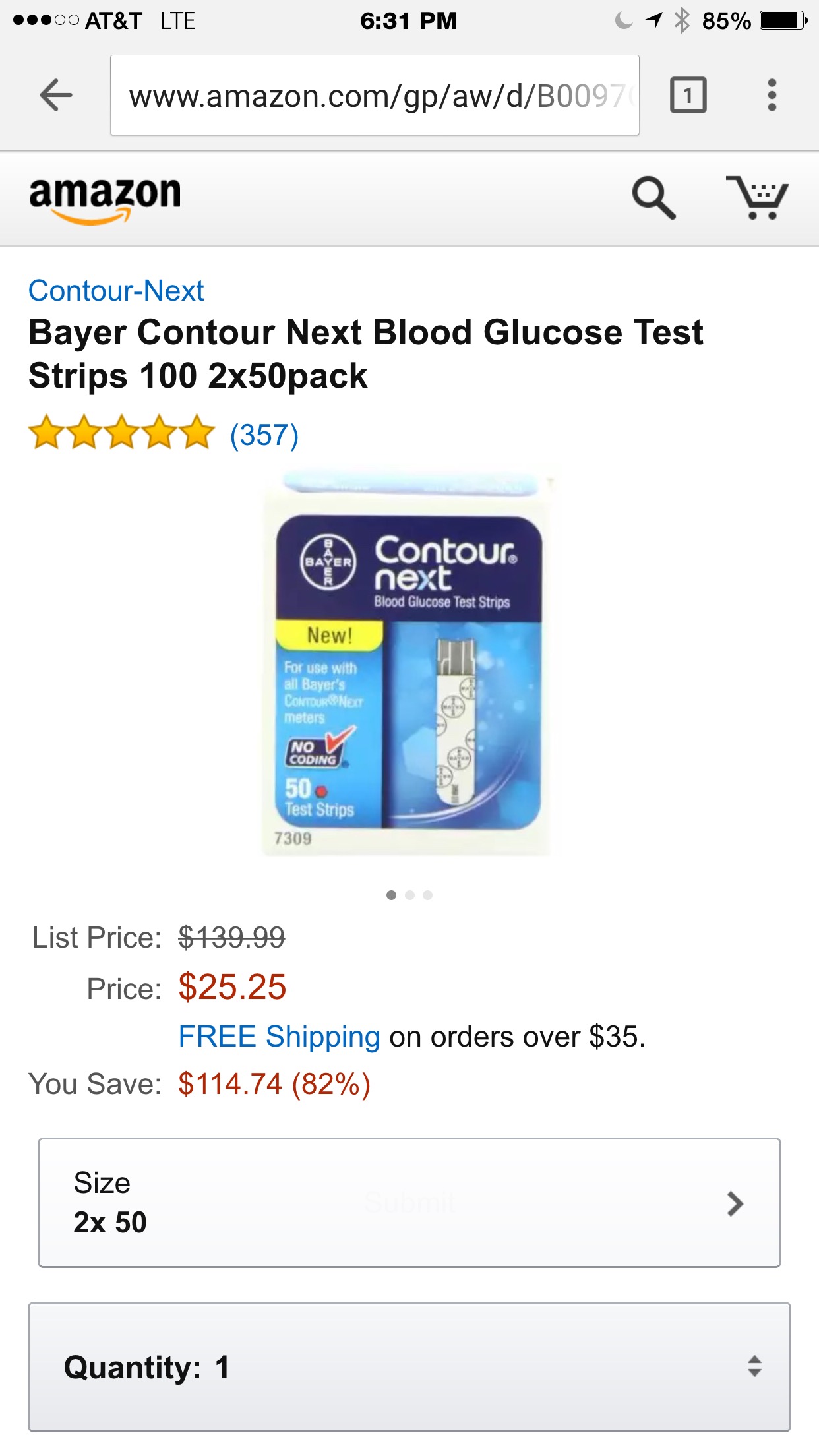
Since I first started investigating and researching this, prices on glucose meter test strips have dropped substantially. Below are listings on Amazon from companies trying to drop their inventory at distressed price reductions of up to 82% off the previous retail price. Click any image for a larger gallery view.

Test Strip Price Reduction

What the Healthcare Industry Tells You

Ask just about any doctor about glucose testing, and they will try to convince you that you don’t need to pay attention to your glucose levels during the day “because the numbers fluctuate so much and are meaningless.”

Yet, anyone actually testing their own glucose levels will quickly learn how their body responds to various kinds of foods and exercises, and the impact of a sedentary lifestyle becomes measurable.

Positive results of varying degrees can be seen in a matter of hours, days, and weeks. Some exercises have a greater impact than others. Depending on the carbs, sugars, glycemic index, and your own unique metabolic processes, different foods will impact your glucose levels differently.

All of this can be learned by strategically performing your own glucose testing.

Clinical Research for $1 Per Day

We’re talking about in-home clinical research that’s about as complicated as an elementary school science project and costs about 45 cents to $1 per day, and it could save lives. Yet, even with the recent 85% drop in cost (for the CVS test strips), insurance companies refuse to pay for it and most doctor’s don’t suggest it.

The fact is that most people are on their own with regard to predictive and preventative care. Even if you go to an integrative medicine doctor, most insurance companies won’t cover exploratory procedures and preventative treatments.

So, in the case of blood sugar management, if you’re wanting to test frequently, you’ll probably need to pay with your own money to get a glucose tester and test strips, because in some cases insurance companies will only cover the cost of brand name testers, and even then they only cover one test strip per day.

It’s up to each individual to clinically study and learn about their own health conditions to develop a personalized wellness regime. This doesn’t mean that you give up on medical care entirely. It means that you dig deeper to learn more about yourself.

Any health plan should be done in collaboration with an practitioner of integrative medicine, and it’s good to continue with a traditional doctor for whatever minimal care is offered by the insurance companies.

Danger! Call your doctor immediately!

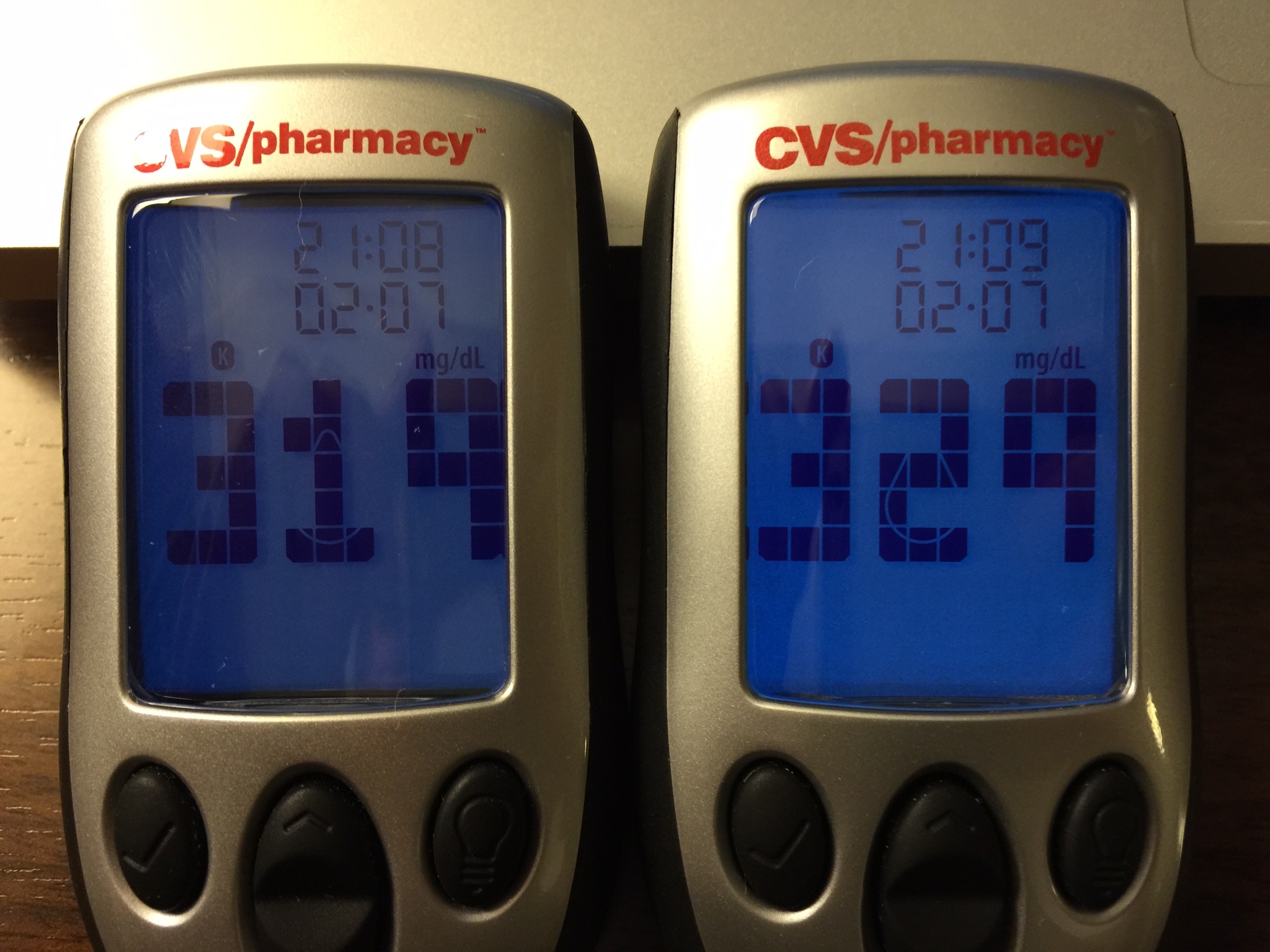
About a month ago, my glucose levels were reaching over 300 as you can see in the reading below.
20150314sa-glucose-reading-blood-sugar-over-300-IMG_0076

The standard medical advisory for readings this high is: “Danger. Call your doctor immediately.” (Source: University of Washington)

I was alarmed. I knew I had to do something. So, I did, and below you can see the results before and after about 30 days later.

20150314sa-glucose-reading-blood-sugar-over-300-before-after-IMG_0078-1024x800

Background

I should share some of the background leading up to my high glucose reading. By the way, when I saw the reading above of over 300, I didn’t call my doctor immediately.* Here’s why…

For many years I’ve been periodically testing my blood sugar levels. Year after year, they were normal.

In the fall of 2013, I’d started using a protein drink mix called Muscle Milk. I created a video about the experience. The protein drink does what it promises. It produces amazing levels of energy and strength. However, in the process, it seemed to raise cholesterol, blood pressure, and blood sugar levels.**

However, I didn’t realize what was going on with my health, until several weeks into using the product and I had my annual physical. The doctor immediately declared me to be a diabetic, wanted to put me on high blood pressure medication, and was alarmed about my cholesterol levels. I was really surprised since I’d not previously had trouble with my blood sugar being high. Yet, it was close to 140 according to the lab work. That’s the highest I’d ever seen it.

I explained that I’d been using a nutritional supplement that I suspected had skewed the lab results. I asked if we could wait on the high blood pressure medicine. The doctor reluctantly agreed to wait on the high blood pressure medicine, but insisted that I take Metformin to help regulate my blood sugar.

I thought to myself, “What could go wrong?”

Well, here’s what went wrong.

I started taking the Metformin prescription and noticed my blood sugar levels were increasing. Every few days the numbers were higher. Soon my blood sugar levels were up to 180, then 220, then one day they reached 285 while on the Metformin. “This is crazy,” I thought.

I immediately stopped taking Metformin, and did some online research. I read that “patients taking metformin can also experience high blood sugar.” (source) I’m glad I’d been checking my blood sugar regularly rather than once per day in the morning. Otherwise I might have been unaware of the danger I was in.

For me this was just another disappointing experience where I was trying to play by the rules, and doing what the doctor had ordered, and my condition became worse.

It took me months to bring my blood sugar levels back down. Without much provocation at all, they’d be back up again. The extreme reaction I was having to foods high in sugars and carbs was alarming, but it allowed me to have a very sensitive measurement tool to evaluate a lot of different foods.

Using my own body as a research lab, I tested various foods and exercises to learn more about their impact on glucose levels. By February 2015, the testing was over. It had to be. Eating a typical American diet was resulting in blood sugar levels of over 300.

I gathered all my research from the past year of testing, and put it all to work. The result was a return to normal levels in about 30 days.

I’m going to publish more details about my findings in the coming weeks.

To learn more, read the health section of my March 2015 news update.

Video

Below is an video I discovered on 26 March 2015 (after writing the article above) that seems to confirm some of my own findings. In the video, Dr. Attia states, “I dream of the day when our patients can shed their excess pounds and cure themselves of insulin resistance because as medical professionals we’ve shed our excess mental baggage and cured ourselves of new idea resistance sufficiently to go back to our original ideals. Open minds. The courage to throw out yesterday’s ideas when they don’t appear to be working, and the understanding that scientific truth isn’t final but constantly evolving. Staying true to that path will be better for our patients, and better for science. If obesity is nothing more than a proxy for metabolic illness, what good does it do us to punish those with the proxy.”

Video Description: “As a young surgeon, Peter Attia felt contempt for a patient with diabetes. She was overweight, he thought, and thus responsible for the fact that she needed a foot amputation. But years later, Attia received an unpleasant medical surprise that led him to wonder: is our understanding of diabetes right? Could the precursors to diabetes cause obesity, and not the other way around? A look at how assumptions may be leading us to wage the wrong medical war.”

__________

*Advisory. In the experience I described above, I didn’t call my doctor immediately because it was the doctor’s previous advice (I believe) that put me in the situation I was in. I knew I had practices that could bring my blood sugar down. So, I implemented those. I’d read of people with blood sugar levels of 400, 500, or higher who were alive to write about it. There were varying opinions about the significance of a reading over 300. For anyone else in the same situation, I’d suggest that you do call your doctor if your blood sugar is elevated. Also, don’t stop medication simply as a result of reading this article, and don’t ‘experiment’ with foods to the point that they hinder your health. My experience was that the recommended glucose medication made things worse. That’s not necessarily the case with all prescriptions. It’s an exception.

**Disclaimer. The document describes the impact of Muscle Milk as a personal experience and not necessarily as a broad statement about the product and how it might impact a majority of people.

Document History

  • 6 Apr 2023 — Document formatted to use the WordPress block layout standards.
  • 14 Mar 2015 — Document originally posted online.

Greg Johnson – Personal Update 201503

Personal Update 201503 | 14 March 2015 | Saturday

20100104tu-gregory-johnson-by-makur-jain-IMG_1164-198x198-square

Greetings,

I hope your’e doing well. Thanks for taking a moment to read my latest update. This month’s topics are writing and health.

You’ll notice I’m sending out my personal update earlier than usual. Rather than waiting until the end of the month, I’m hoping to start doing my newsletter writing near the start of each month.

Writing

I first developed an interest in writing when I was in high school and one of the first computerized  word processing systems became available — running on a Radio Shack computer. I was amazed by how a word processor could completely revolutionize writing. I’ve been writing regularly since then. Most of my writing over the past 20 years has concentrated on reference documents, commentaries, product reviews, and other articles without the first person reference or perspective.

Other than my Put Your Life on a Diet book, I really don’t have much experience writing stories of fiction or non-fiction.

A recent attempt at fiction writing was the short story “Rezifp Dawn” that I started in May of 2012. After five installments, I stopped writing, but I very much want to return to it since there’s more to the story.

This month I started doing some story telling from my own life experiences including the writing “What a Leader Looks Like” about leadership and business management. In that writing I share some of my own experiences and observations about leadership.

I’m also programming my writings to be time released. So, after writing them, I set a date and time of publication for each writing. That gives me some time to reflect on them. The outcome is a more refined and distilled product. It also means that I can have writings in a queue that get automatically released periodically in intervals. This news update you’re reading now was written Friday evening, but scheduled to go live at 3:00 AM on Saturday.

Health

My main emphasis in recent months has been to cut back on some of my other activities to focus more on optimal wellness practices.

Over the past few years I’ve been working on developing a unified wellness protocol that can reduce blood pressure, lower blood sugar, improve blood cholesterol, and reduce weight. By unified, I mean a single multi-phase protocol that addresses all these conditions over time.

One local doctor I spoke with believes that bariatric surgery for weight loss and pharmaceutical drugs for the other conditions is the best solution to these common health problems. By contrast, other doctor’s I know who practice integrative medicine recommend specific diet, exercise, and lifestyle changes for meaningful long-term health improvements.

Those who practice P4 medicine believe that healthcare should be Predictive, Preventive, Personalized, and Participatory. Predictive medicine gathers data that can help reveal expected trends and outcomes. Preventative means developing and implementing a plan of corrective action before it’s needed. Personalized means each person has a program specifically designed for their unique situation. Participatory means that the ‘patient’ isn’t just receiving orders from a doctor, but participating in the entire process of developing a plan that will work.

While it’s true that many severe illnesses can be corrected or prevented by lifestyle changes, making those lifestyle changes can be difficult. There are many plans that work, but if you can’t work the plan it’s worthless.

A multi-phase approach, like the one I’m developing, makes it easier to succeed with major lifestyle changes. For example, instead of simultaneously targeting multiple conditions with parallel treatments, it’s possible to target specific conditions in a certain order and then build on that foundation. Leveraging one cure against another condition to bring it down next.

The order in which conditions are addressed makes a difference. In the fall of 2014, over time, I was able to stop consuming foods high in sugar by eating breads and carb dense snacks as my ‘go to’ nibble food. I was then able to stop consuming breads and other high carb / high glycemic index foods by using cheese and other dairy products as a reward. At some point you grow tired of cheese and the body naturally begins to crave more nutritious foods once the hunger stimulating influence of sugar has been thoroughly removed. Other items such as coffee, foods high in the unhealthy types of fat, fried foods, and foods high in salt are shedded along the way.

There are a few exceptions, such as Ezekiel 4:9 bread which, although it’s called a bread, is an entirely different kind of food and processed by the body differently because of the sprouted grains used. So, rather than causing blood sugar to increase, it seems to powerfully reduce and regulate glucose levels (at least in my experience with it).

Some foods and activities that seemingly have no health benefit, can have a strong beneficial impact after clearing the body of debris. Like working the soil before planting a garden, getting rid of sugar and other toxins really creates fertile conditions for greater positive change. Context is critical, and efficacy is often highly volatile based on existing conditions.

Food preference is one of the traits we commonly use to describe who we are. So, permanently changing your food preferences changes the core of who you are. It’s not about using herculean efforts of self control to avoid eating foods you’re craving. It’s about changing the cravings. These are two entirely different approaches.

The process is probably similar to drug addicts slowly stepping down to less addictive drugs over time to eventually get free of drug dependency. With combinations of sugar, carbs, fat, salt, caffeine, and flavor enhancers, some food products can be almost as addictive as drugs — which explains the slogan “bet you can’t eat just one.”

Indeed, much of the snack foods available are clinically developed and lab tested to powerfully activate addiction centers in the brain. (source) Not only are they addictive, but they increase hunger while seemingly blocking brain receptors that tell us we’re full. It’s really a dangerous combination that’s programmed to have a single outcome: more consumption which leads to obesity, which leads to more consumption, which is accompanied by the common ailments I mentioned above.

There’s some truth to the Tyson’s commercial below showing the insatiable appetite that a person has when eating snack food.

[youtube https://www.youtube.com/watch?v=NFDb4LH76ss?r=0]

I’ve discovered some common fast food products and grocery store foods that anyone can use to raise their blood pressure, blood sugar, and cholesterol to dangerous levels in about 30 days. I’ve also discovered some common grocery store items that can do the opposite. Most of the natural supplements and healthcare devices I’m using can be found at a corner drug store.

By following the wellness program I’m developing, I’ve been able to drop blood sugar levels by over 200 points from dangerous levels to normal levels without medication. I’ve reduce blood pressure from persistent clinical hypertension down to consistently normal (or slightly below normal) levels, also without medication. I’m now entering the cholesterol reduction and weight loss phase. This is where I’ll be significantly reducing intake of cheese and other high cholesterol foods, while increasing intake of foods known to reduce bad cholesterol.

In addition to dietary modifications, I’ve started doing regular stair climbing throughout the day. I’ve already lost 12 pounds since February 9).

There’s a lot more to this program, including some interesting wireless data collection tools (similar to biotelemetry systems) that automatically collect health data and present it in a meaningful way for actionable responses. Most of these devices are available on Amazon. This is a subset of the XTX4 project I’m working on.

I’ll be sharing more about the details of this program, and hopefully some ongoing success with it in the coming months. I plan to make the program open source and public domain.

Many thanks to all of you who keep in touch and provide support for the work I do.

~ Greg

__________

Origins. For those of you who are new to these monthly personal updates, they began over a decade ago out of a desire to share from my personal life about topics of lifeways, health, career, finances, relationships, effective living, and activism. This is based on the life map presented on the Resources For Life website.

What a Leader Looks Like

Having spent most of my career as a technology service and support provider, I’ve grown to appreciate others in the industry. Even if someone is your ‘competition’ you inevitably acknowledge and give them credit when they are doing things right.

At some point along the way, as a consultant you find yourself with an abundance of work to do, or you’re on vacation, or there’s someone outside of your service area, and you need to recommend a business you can trust. One such business is Erb’s Technology Solutions in Cedar Rapids, Iowa. They’ve been in business since 1961 and have many satisfied customers.

One day I had to deliver a printer for one of my clients to their facility for some in-warranty repairs. As I recall, back then, the equipment service entrance was on a lower level at the side of the building. I thought I’d take the opportunity to visit a bit with the employee working at the service desk.

The service reception desk is generally not the most glamorous job. The pay isn’t great. Usually a less experienced technician would work at the receiving and pickup area. It’s sometimes an unpleasant job if customers are upset about failed systems, crashed computers, delays in repairs, and/or unexpected repair costs.

I had a good talk with the technician that day. I let him know that I’m an area tech consultant and have been impressed with their business. He was very friendly.

When I asked his name, he told me he was Larry. Then I realized, I’d been talking to the owner of the business, Larry Erb.

At that point I just had to ask… why was he working at the service desk? Usually the owner of a successful business that size has managers who manage the managers who manage the employees.

What I learned is that he likes to have some hands on emersion in the various departments in his business. It gives him an opportunity to evaluate continuous improvement opportunities for better procedures and practices. It also lets him have direct contact with his customers and hear first hand about their experiences with his business.

Leaders are sometimes portrayed as people who are removed from the ‘commoners’ and  inaccessible. It’s assumed that one of the perks of being the boss is that you don’t have to do the dirty work and heavy lifting. You’re able to escape from listening to customer complaints. Yet, these portrayals of leadership aren’t the ideal.

A true business leader isn’t trying to avoid their employees or the customers they serve. A true leader spends some time with their sleeves rolled up, working side by side with their employees and serving customers. This builds relationships and trust. It also helps an innovative leader explore opportunities for improvement — since ultimately that’s what their highest calling is.


Related Media – Audio

The audio below is from 7 April 2003. It’s the story of how this kind of management style became the foundation for Honda’s success — success in job satisfaction, customer satisfaction, product quality, and customer service excellence.

Related Media – Video

The video below is about a Japanese airline industry CEO who decided to give himself a pay cut as a way of sharing the burden when a depressed economy adversely impacted the company’s revenue. This CEO frequently works along side with employees and listens to their ideas, praises, and suggestions for improvement.

[youtube=https://www.youtube.com/watch?v=PjeTTQKRfWU]


About This Article

“In 1987, at 23 years old, I had my first experience with leadership and business management as a manager of a Radio Shack store in California. Going from a recently hired sales person, to managing my own store in 6 months was a kind of a record. In the 28 years since then, my interest in leadership and management has grown. I’m intrigued by innovative approaches to facilitating progress for organizations and businesses. Much of what I’ve learned over the years, I’ve applied to my work as President of the Small House Society (2002 to present). I describe myself as a “facilitator” in my work with the organization. I like the term facilitator because for me, that’s what a leader does — empower, equip, inspire, and help people grow in their areas of passion and expertise. So, the above article is inspired by these experiences.” ~ Greg Johnson, 12 March 2015


20140524sa-des-moines-canon-t2i-by-greg-johnson-IMG_3674

NPR Tiny House Interview with Tom Ashbrook

On 4 March 2015, I had a nice interview on NPR with Tom Ashbrook and some other tiny house enthusiasts. Click the play button below to listen in.

Below is a description of the show from Tom Ashbrook:

For years, Americans have been on the McMansion trail. Bigger and bigger homes have driven up the average size of US accomodations and expectations. But there is a counter-movement, the “tiny house movement,” that is pushing for just the opposite. Pushing for – and building and living in – teeny tiny houses. Five hundred square feet. Four hundred. Three hundred. Two hundred. And tiny apartments, too – micro-apartments – gaining interest. Backers. Dwellers. The tiny house people say it’s all about living light. Maybe living better, in a very small space. This hour On Point: tiny houses, and the urge to live small.

Guests

From Tom’s Reading List

NPR News: Living Small In The City: With More Singles, Micro-Housing Gets Big — “While the average size of new houses gets bigger every year in the U.S., some people are trying to do more with less. A lot less. Tiny houses and micro apartments are now a niche trend in the housing market. Smaller spaces are touted as more environmentally friendly, more affordable and perhaps even more communal. The idea is you might be more likely to get out and be social if you live in a smaller space.”

WFAE: Big Challenges For Tiny Houses In North Carolina — “If you could design your dream home, what would it look like? A big house with a four car garage? Maybe something more modest but efficient. Places like Portland, Oregon and Washington, DC have communities experimenting with small living spaces known as tiny houses. North Carolina has caught on to the tiny house trend—homes that are tiny by nature, but artistically designed for those looking for a more compact way of living without going into much debt. ”

The Oregonian: ‘Portlandia’ tiny house: Fred and Carrie have never been so close — “Are you searching for an affordable home in Portland’s Alberta Arts District? Does your soul want sustainability yet your heart yearns for luxuries like a master bathroom with soaking tub, TV and a window framing landscape? Would an efficient home office and library filled with classics feed your mind? The tiny house that stars in Thursday’s episode of ‘Portlandia’ might be the perfect fit. If you can squeeze in.”

Greg Johnson Talks Tiny Houses on National Public Radio

Greg Johnson of the Small House Society will be featured on a special OnPoint radio broadcast along with others involved in the tiny house movement. The show will be live on National Public Radio (Boston, WBUR).

Date: Wednesday, 4 March 2015

Time: 10AM to 11AM Central Time (11-12ET, 9-10MT, 8-9PT)

Facebook. Learn more and signup for the live online broadcast here:

Facebook.com/events/1376517885988268

Listen LiveWBUR.org/listen/live

Participants Needed (ASAP):

Two Radio Interview Participants Needed! Sorry for the short notice, but we’re hoping to find two people who would like to be interviewed on this hour-long National Public Radio show about tiny houses. This would be a call-in interview, so you wouldn’t need to travel. We want to round out the guests on the show, so we’re looking for one woman, and one man to be guests. One should be living in a tiny rural tiny home. The other should be living in a micro apartment. Neither guest should be living in Iowa City or Washington. Preferably younger millennial/hipster micro home dwellers. For details, contact us as soon as possible. Thanks! Please contact us if you’re interested.

20150303tu-portlant-tiny-house-DSC06257


Greg Johnson – Personal Update 201502

Personal Update 201502 | 28 February 2015 | Saturday

20100104tu-gregory-johnson-by-makur-jain-IMG_1164-198x198-square

Greetings,

Thanks for taking a moment to read my latest update.

Health. Last fall, I began reducing my consumption of sugar and coffee. Then I began reducing my intake of breads, pastries, and other foods high in carbohydrates. During this time, my indulgence was to eat various kinds of cheese. Now, almost 7 months later, I find I’ve lost my appetite for sweets. By using cheese as a treat, it was much easier to stop eating sugar, coffee, and breads. What’s really interesting is that I thought I would have a hard time quitting cheese. Yet, now, I don’t even crave cheese any more. Soon, I hope to post the list of foods that I’m eating. It’s a list I developed that’s mostly low-carb low-glycemic-index superfoods.

Technology. I wrote 14 technology related articles in February. One article is about how you can save hundreds of dollars on a standing workstation. The most recent articles are listed in the right column on my technology website.

In the News. I enjoy working with the media. Sometimes this involves working behind the scenes helping with news, articles, and television shows — mostly about small houses. I’m sometimes called upon by local media to help meet story deadlines. This past month I was interviewed by Fox News for a story about Phishing Emails and another brief appearance was for a story about shopping mall security.

Reflection. I recently learned that someone I know has cancer. Out of respect for their privacy I won’t go into any details, but the experience has reminded me of how indiscriminately ravaging cancer can be.

Inspiration from Advertising. As you may know, I’ve always had an interest in various aspects of advertising, especially inspiring ads. There are several inspiring ads recently produced by WestJet. The video below is an example.

[youtube https://www.youtube.com/watch?v=oeX1H7ajOvQ?rel=0]

Many thanks to all of you who keep in touch and provide support for the work I do.

~ Greg

__________

Origins. For those of you who are new to these monthly personal updates, they began over a decade ago out of a desire to share from my personal life about topics of lifeways, health, career, finances, relationships, effective living, and activism. This is based on the life map presented on the Resources For Life website.

Centralized and Distributed Support Models in Service Industries

Introduction

In service industries, centralized or distributed support models both have benefits and drawbacks. This document explores what these benefits and drawbacks are. Although there are people with strong opinions about which model is better, as you’ll read here, there are different benefits to both systems, and when implemented properly, those benefits can be achieved. When either system is implemented poorly, outcomes suffer. As explained below, a hybrid model is also possible that can achieve many of the benefits of both approaches.

Centralized Support Overview

Service industries generally operate from a centralized model, especially within larger organizations and companies. The Best Buy Geek Squad would be an example of this. For many businesses, instead of having an in-house specialist to provide support, they call to get help or have something fixed, and a person comes to fix it. For those working in these kinds of service industries, the center of community, friendship, and camaraderie is within the community of support providers at their central office. When the Best Buy Geek Squad comes out to setup your new television, they don’t stay for dinner.

In-House Support Overview

The alternative to centralization is to have a full-time on-site in-house support person. When small businesses grow to a certain size, they reach the point where hiring a person full time can be less expensive than paying higher hourly rates to have a consultant to come in occasionally or part-time. Larger organizations and businesses may have many support people on staff who are spread around in the areas where they are needed for easier access. In this business model, the support people may feel a greater sense of belonging, community, and camaraderie with the people they are serving. Knowing more about those we serve, helps us serve them better, this combined with greater accessibility, creates opportunities for preventative and proactive approaches.

Benefits of Centralization

There are a number of benefits to having a centralized service model:

  • Scalable. With a centralized team of support people, it’s possible to respond to just about any need with just the right amount of support.
  • Specialized. Specialists in the team, with much more experience than a generalist, can deliver higher quality support as needed — shared across multiple units.
  • Better Tools. When specialized repair tools and resources are shared, they can be of higher quality and more variety.
  • Collaborative. A central team of support specialists are more likely to build collaborative and supportive relationships.
  • Standardized. When people are working together as a team, it’s easier to arrive at and implement standard practices.
  • Load Balanced. Having cross training and redundancy of support personnel ensures users get support even if someone is on vacation or sick. It’s also less stressful for an employee who knows that they can take time off without it impacting their work negatively.

Overall, the outcome of a centralized service model should be a higher quality of support and a greater quantity of support. In the long-term, it should be better for all people involved. A win-win situation.

Benefits of Distributed Support

Here are some of the benefits of distributed support:

  • Integrative. There’s a significant team-building and unifying benefit from having all employees working together having an opportunity to collectively experience shared successes. When support staff have a home among those they support, and have a sense of belonging, they can work more smoothly as a team.
  • Immediate. Being more easily accessible, support people who are close to those they are serving will be utilized more. Even the simplest elevator conversation can lead to a breakthrough in efficiency.
  • Trust Building. Being part of the community they serve, support specialists are more trusted. Trust includes believing that you can rely on someone, and that you believe in their level of competency.
  • Engaging. When service and support employees are daily working side-by-side with the people they are supporting, they can make sure people are aware of and utilizing best practices and following established standards and policies.

An Analogy to Cluster Storage and Computing

Anyone who has had their files stored on different hard drives knows that each drive will inevitably have free space left on it, sometimes a lot of unused free space.

A RAID file system allows you to combine many different hard drives into what the computer perceives is a single large drive. Previously unused space on many different drives is combined and available for use rather than scattered around.

Cluster Computing and Network File Storage systems provide this same efficiency. Technology is centrally located, and utilized by a large group of people, significantly reducing the otherwise unused drive space and underutilized computing power that might have been scattered around throughout an organization.

Well, the same principles of efficiency are present with human capital management strategies for service industries. Centralized service delivery models create a cluster of people in one location who can be called out on demand as needed, rather than being spread around an organization.

Fluctuations in Support Needs

When support people are distributed, they will likely experience the inevitable fluctuation of workload and support needs from one day to the next.

In service industries, it’s unlikely that workers will each individually have precisely 40 hours of work to accomplish in a given week if they are supporting a specific group of users.

From week to week, the support needs change. Usually what happens is that support people put in more hours to keep up, and sometimes quality suffers.

A Lesson From Urban Planning

For several decades, municipalities have struggled with a planning model that was largely dependent upon automobile ownership and use.

Rather than having walkable communities with mixed use urban spaces, cities have been designed to have shopping malls on one side of town, an industrial park on the opposite side of the city, a business park might be on the outskirts of town, with suburbs and sprawl were situated elsewhere. The downtown would be mostly office buildings. In none of these places were there opportunities or venues where community could be built.

New urbanism and walkable communities are designed so that people might live, work, shop, eat, and socialize all within the same neighborhood or downtown area.

With this in mind, we can think about service delivery models. A centralized service delivery model has all employees checking in at a central office and going out to deliver services as needed. Not as many opportunities exist for building collaborative relationships with those being served.

A distributed service delivery model is like new urbanism and walkable communities. From day-to-day, service people share the same office space and facilities as those they serve. Relationships are more easily established. The working conditions are such that collaboration is fostered and less of an effort.

In some office environments, people serving different roles work in the same proximity: graphic designers, sales staff, marketing, office managers, receptionists, secretaries, and tech support staff. This helps build relationships and provides easy access between different team members.

Imagine separating out one group of employees based on their role, and not allowing them to interact socially with the rest of those in the organization or company. Rather than feeling like they are part of the bigger team of employees they serve, they’d likely feel removed and possibly less valued.

A Lesson From Permaculture

In the midwest agricultural states, it’s common to have thousands of acres dedicated individual crops like corn or soybeans.  In a permaculture model, food and other vegetation is grown strategically together to create a self-maintained habitat.

Huge cubicle farms of employees grouped together by specialty reflect a monoculture model rather than a permaculture model. Rather than building small diversified workplace community centers, cubicle farms are focused on workplace efficiency.

The Intersection of Arts and Sciences

There’s been a lot of talk about interdisciplinary collaborative efforts. A liberal arts and sciences environment is based on the idea that a diversity of academic disciplines, when interwoven, can create an environment that fosters creativity and innovation. A blended workplace community of employees creates an opportunity for interdisciplinary partnerships.

A Lesson from Healthcare

In the traditional approach to healthcare, you visit your doctor once a year, and get an annual physical. The doctor visit may last 10 to 15 minutes — just long enough to get vitals, check ears, check throat, and listen to the heart and lungs. No exploratory lab work is done unless some symptoms have manifested that suggest further exploration is needed.

Only when there’s acute pain or an injury do we visit the hospital outside of our regular annual physical / checkup. As a result, many life threatening conditions and illnesses fester underneath the surface. By the time they are identifiable as symptoms, it’s too late to prevent them.

In the new model of healthcare, visits to the doctor are more regular and may last 60 to 90 minutes. The healthcare provider learns about your home life, work life, diet, exercise routine, sleep, and other factors that impact health. Extensive lab work is done to identify indicators of potential health problems on the horizon. This approach to healthcare seems to take more effort, yet in the long run can help prevent very costly surgery and life threatening illnesses that are all preventable. Because of the relationship established between doctor and patient, it’s more likely that the doctor can encourage, equip, and inspire the patient to make life changing life choices and changes in diet and exercise.

If we we take this approach to service industries, we will find that problems are less severe, less frequent, and cost less to fix in the long run.

Hybrid Solution

A hybrid model of service delivery would call for centralized administration and oversight of support staff, but support staff would have their offices mixed in with those they are supporting. An effort would be made to maximize ‘time in the field’ and reduce time in meetings and conferences. This support model provides benefits of both centralized and distributed support. Employees would report to the administrative members within the group they support, and also report to their central office management.

UPDATE: 5 May 2023

I’ve written an update and addendum to the above article. To learn more, read, “Tech Support: Small Scale — At Scale.” [View]

__________________

Page Visitors

Thanks for taking an interest in this article and sharing it with others. The maps below show recent page visitors from around the world. It’s nice to see there’s ongoing interest in this article more than eight years years after it was published.

Below are recent visits as of 5 May 2023

Below are recent visits as of 2 Sep 2017

20170902sa0709-support-models-by-greg-johnson-page-visits

Document History

  • 5 May 2023 at 4:20 PM — Added addendum note at the bottom of the document to an additional related article. Updated page formatting for the WordPress block editor. Added updated recent visitor map.
  • 8 Feb 2015 at 9:36 PM — Document initially posted.
20150228sa-shutterstock_71959618-office-people

Road and Traffic Planning to Reduce Road Rage

Every morning, rush hour traffic heading east into Iowa City on Melrose Avenue is abruptly forced into one lane just past Emerald Street as the right lane ends.

Most drivers know this and stay in the left lane which backs up and creates a long line of traffic in the left lane.

Inevitably, every morning, there are drivers who see this as an opportunity to cut ahead in line. So, they drive over the speed limit to race ahead in the right lane hoping to cut in at the last moment.

With a feigned look of ignorance and pity, they look back at the drivers next to them hoping someone will let them in. The more brazen drivers try to force their way in, as if it’s their birth right. They will drive up on the curb to show their determination. Some get forced off the road by angry people who have been patiently waiting their turn.

Those who stand waiting for the bus every day see this drama unfold like clockwork. Today, unfortunately, an ambulance with lights and siren on, was unable to get through as unrelenting drivers refused to give up their precious spot in line. So the ambulance just sat there. Eventually the flow of traffic picked up and one driver let the ambulance go ahead.

If a traffic signal were put in on the eastbound side of Melrose Avenue, this could solve the above problem. A left turn only light could designate the left lane for only those cars going into the Finkbine commuter lot. All other traffic could stay in the right lane. This would also help regulate the merging of traffic.

For streets near a hospital, such traffic jams should really be prevented.

20150223mo-iowa-city-melrose-avenue-traffic-jam

CBS News: Shopping Mall Security and Safety Concerns

On Monday, 23 February 2015, CBS News produced a story about shopping mall security and safety concerns. I had an opportunity to be briefly interviewed for that news segment. The video is below and the story is also available on our local CBS website.

[vimeo=https://vimeo.com/120499177]

In visiting with the news team, I pointed out that our local shopping malls are mostly single-level and spread out over a large area, so they are not densely populated which makes them less likely targets for terrorist attacks. With a trend toward supporting small locally owned businesses, people are doing less shopping at malls, and seeking out small local businesses to support.

In other countries I’ve traveled to, the shopping malls may have three or four levels and are more densely populated making them a higher risk security concern. Heightened security measures are in place, with security guards checking under cars with mirrors and mall visitors are required to go through metal detectors.

In the United States, with some exceptions, many malls simply aren’t the hub of activity and community that they are in other countries.

20150224tu-cbs-greg-johnson-shoping-mall-security

The Ineffectiveness of Procrastination

Procrastination is partly a desire to reduce our work and effort, at least in the moment. Yet, by postponing inevitable work until later, we’re usually doing a disservice to our future self.

There are many areas of life where the “put it off until later” attitude results in less effective outcomes. Here are some examples…

  • Waiting until the dishes absolutely need to be done, and then cramming them all into the dishwasher piled one on top of the other reduces the efficiency of the dishwasher. At that point, dried on food is difficult to remove.
  • Paying credit cards later results in higher fees.
  • Waiting until the car doesn’t run and then taking it to a mechanic, when’s so much damage has been done that major repairs are needed.
  • Only studying the night before an exam without studying throughout the year won’t produce the best results.
  • Rushing through a project shortly before a deadline and not giving it the time and breathing space needed to create something innovative and high quality.

Preventative approaches to every area of life have a huge impact cumulatively and result in a better quality of life with less stress.

20150221sa-dishes